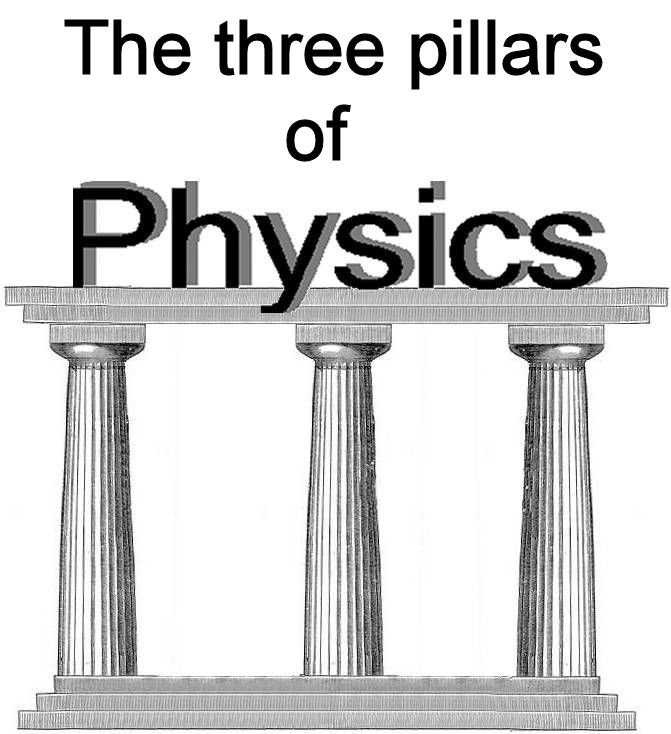
Why three pillars?
I call the three pillars: conceptual, experimental, and analytical-computational. Let’s take a look at each of these.
- Conceptual:
Before you can proceed with any of a great variety of physics problems, that make up the meat of any homework assignment, test, or exam, you must have accurate descriptions of phenomena you are looking at. You might need to learn new terminology to describe what you’re observing.
- Experimental:
The next step is to take measurements on what you are observing, then follow up by recording and displaying your measurements in meaningful ways.
- Analytical-computational:
Once you’ve made sense of the concepts and the cause & effect relationships between them, you can understand the equations you’ll be working with. This will allow you to analyze your data, perform calculations, and arrive at new results.
You will constantly be jumping back and forth between thee three pillars.
Observe. Measure. Calculate. Welcome to the world of physics.
One more thing: You are now off to physics boot camp.